
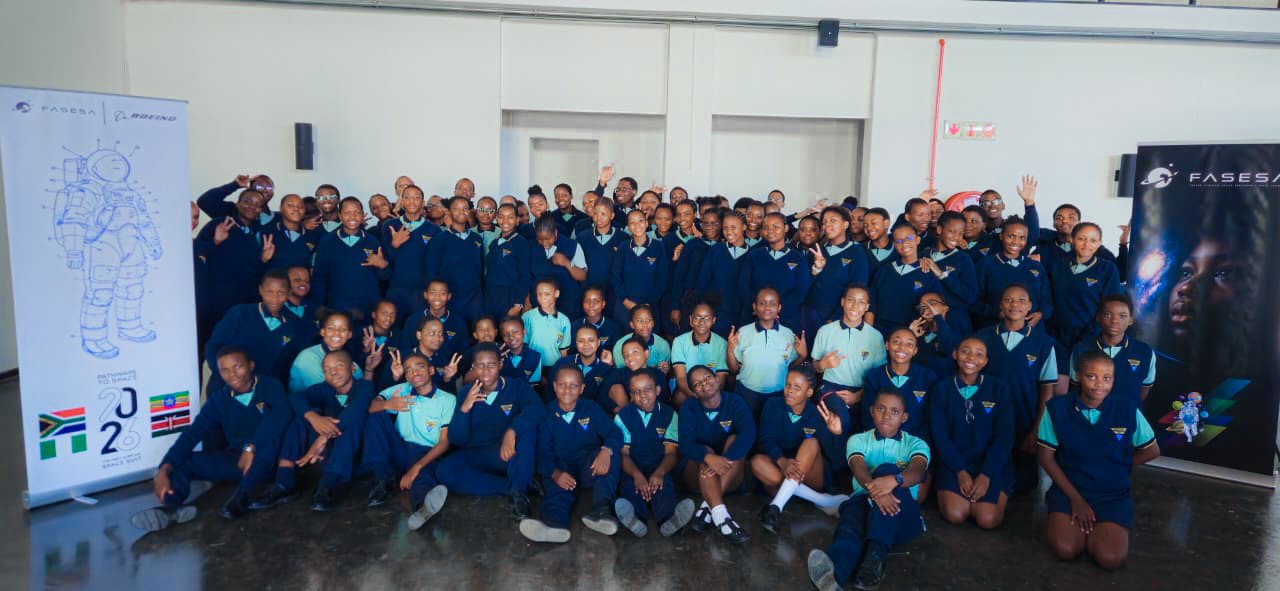
Ethiopia, Kenya, Nigeria, South Africa, March 4, 2026 - The Future African Space Explorers STEM Academy (FASESA) and Boeing [NYSE: BA] have launched the third edition of the Pathways to Space program, expanding to South Africa for the first time. This year the team plans to train more than 2,000 high school students aged 13–18 in Ethiopia, Kenya, Nigeria and South Africa.
The program is delivered in collaboration with local educational and government institutions, with participating state schools identified by national Ministries of Education and Ministries of Science and Technology.
“Almost every child dreams of becoming an astronaut, but the space industry offers far broader opportunities — from building satellites and spacecraft and designing hardware and software to supporting mission control, launch operations, life-support systems and on-orbit research,” said Henok Teferra Shawl, Boeing managing director for Africa. “With its young and fast-growing population, Africa holds immense untapped potential. Through Pathways to Space, we try to connect that potential with real-world skills and future opportunities in the growing space ecosystem across the continent.”
In 2026, program organizers will introduce a new design challenge under the theme “The First African Spacesuit.” Students will explore spacesuit engineering, human factors and materials science through hands-on, industry-aligned learning, including guided design workshops and virtual sessions with former astronauts and global aerospace professionals from NASA’s Johnson Space Center, Final Frontier Design and leading U.S. universities.
Another core component of the program will be a high-altitude balloon mission, during which students will deepen their practical understanding of payload design, atmospheric science and data analysis.
“Pathways to Space has grown into one of Africa’s most impactful space education initiatives,” said Sean Jacobs, founder and executive director of FASESA. “The 2026 program reflects our commitment to expanding access, strengthening technical depth, and equipping young people across the continent with the skills and confidence to participate in Africa’s space future.”
Since its 2024 launch, Pathways to Space has already inspired more than 1,200 students in Ethiopia, Kenya, Nigeria and Tanzania, with plans for further expansion and curriculum enrichment.
The program reflects accelerating space ambitions across Africa, supported by the continental coordination role of the African Space Agency launched by the African Union in 2025. Ethiopia is advancing plans for additional Earth-observation satellites, while Kenya continues expanding satellite applications through the Kenya Space Agency. Nigeria is strengthening remote-sensing and communications capabilities, and South Africa remains the continent’s most mature space ecosystem, with strong expertise in satellite development, space science and data applications.
About FASESA
The Future African Space Explorer's STEM Academy is a young and growing initiative with the aim of bringing space exploration to the African classroom, wherein most learners have barriers of entry to the vocation due to a lack of access to information and resources. For more information about the organization and the ‘Pathways to Space’ program please visit www.fasesa.com.
About Boeing Africa
A leading global aerospace company and top U.S. exporter, Boeing develops, manufactures and services commercial airplanes, defense products and space systems for customers in more than 150 countries. Boeing has been driving Africa’s aviation growth for over seven decades, with Boeing’s market share in African commercial aviation reaching 70%. Boeing has offices in Ethiopia and South Africa and field service representatives working with airlines across the continent. Over the last decade, Boeing has invested $14.5 million in community partnerships with academia and non-profits in Africa. More than 43,500 people have participated in these educational programs across the continent over the last five years alone. For more information, please visit https://www.boeing.africa